






Quick Answer
Most Australian aged care facilities use scrubs for clinical and personal care roles and polo or corporate shirts for lifestyle, hospitality and community care staff. Colour-coding by department is strongly recommended — it helps residents identify who is caring for them, which is especially important for residents living with dementia. There are no nationally mandated uniform colours for aged care in Australia; each facility sets its own policy within the Aged Care Quality and Safety Commission's quality standards framework.
Ready to outfit your facility? Browse the Aged Care Uniforms Collection — scrubs, polos and corporate wear for every role. Or explore facility and group ordering for multi-department programs with logo embroidery.

Aged care is one of the most uniform-dependent sectors in Australian healthcare — and one of the most complex to get right. A residential facility might employ registered nurses, enrolled nurses, personal care workers, lifestyle officers, hospitality staff, administration and management, each with different functional requirements and often different dress code expectations. On top of that, the aged care sector operates under the Aged Care Quality and Safety Commission's standards, which emphasise resident dignity and a homelike environment — something that has a direct bearing on uniform policy decisions.
This guide covers everything a facility manager or care worker needs to know about aged care uniforms in Australia: what each role actually needs, how to approach colour-coding across departments, which garment types suit which environments, fabric selection for high-wash care settings, the printed scrubs question, and how to manage facility-wide uniform programs efficiently. Infectious has supplied uniforms to residential aged care, home care and community care providers across Australia for over two decades — this guidance reflects what actually works in the field.
In this guide:
1. ACQSC standards and uniform policy
3. Colour-coding by department — why it matters in aged care
4. Scrubs vs polos vs corporate shirts — how to choose
5. The case for printed scrubs in aged care
6. Fabric guide — what aged care demands
ACQSC Standards and Uniform Policy: What You Need to Know
The Aged Care Quality and Safety Commission's Strengthened Quality Standards emphasise resident dignity, a homelike environment, and person-centred care. While the standards do not prescribe specific uniform colours or styles, they do shape how thoughtful facilities approach uniform policy. A uniform that is visually harsh, institutional, or fails to differentiate clinical roles from care and hospitality roles can work against a person-centred care environment — particularly for residents living with dementia or cognitive impairment, who rely on visual cues to understand who they are interacting with.
The practical implication is that aged care uniform decisions carry more weight than they do in most healthcare settings. Choosing scrubs versus polos, implementing colour-coding by role, deciding whether printed scrubs are appropriate — these are not just procurement decisions. They affect resident wellbeing, staff identification, and how the facility presents to families and visitors. Getting the uniform program right is worth the investment of proper planning.
Role-by-Role Uniform Guide
Aged care facilities employ a wider range of roles than almost any other care setting, and each has genuinely different uniform requirements. Here is what works for each:
Registered Nurse (RN)
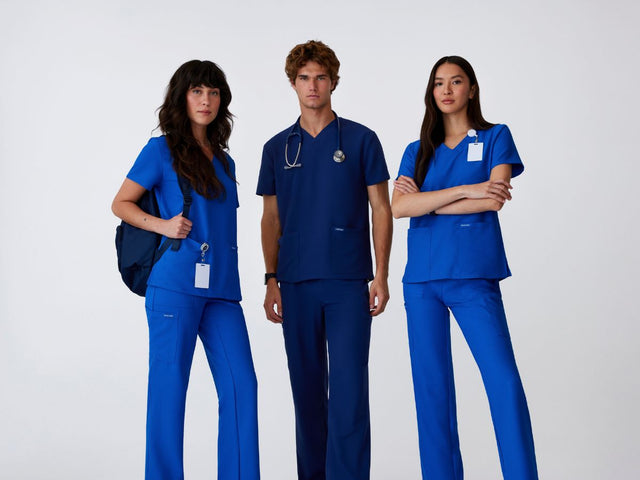
RNs in aged care carry clinical responsibility and need to be clearly identifiable to residents, families and other staff. A dedicated colour — typically navy, ceil blue or burgundy — worn only by RNs establishes this immediately. Stretch scrubs are the right garment: RNs move constantly between residents, clinical tasks, medication rounds and documentation. Cherokee Infinity or Wink Boundless in the facility's designated RN colour work well — both provide 4-way stretch, moisture-wicking performance and hold their colour through the frequent washing cycles aged care demands. Embroidered name and role designation on the left chest is strongly recommended.
Enrolled Nurse (EN)
ENs benefit from a distinct colour from RNs — this matters for clinical governance as much as resident identification. Ceil blue, teal or pewter are commonly used to differentiate ENs from the RN team. The same stretch scrub performance requirements apply. Wink W123 or Cherokee Infinity suit this role well. Name and role embroidery should follow the same format as the RN team for visual consistency.
Aged Care Worker / Personal Care Worker (AIN/PCW)
Personal care workers make up the largest part of most aged care workforces and have the highest physical demand of any role — assisting with showering, dressing, transfers and mobility. Durability and ease of movement are the priorities. Dickies EDS Signature or Wink W123 are the most practical choices: both are robust, easy-care, and available in a wide colour range. A distinct colour from clinical staff — often a warm tone like raspberry, wine or hunter green — works well to differentiate care workers while keeping the palette approachable rather than institutional. Deep pockets are essential for this role.
Lifestyle / Diversional Therapy Staff
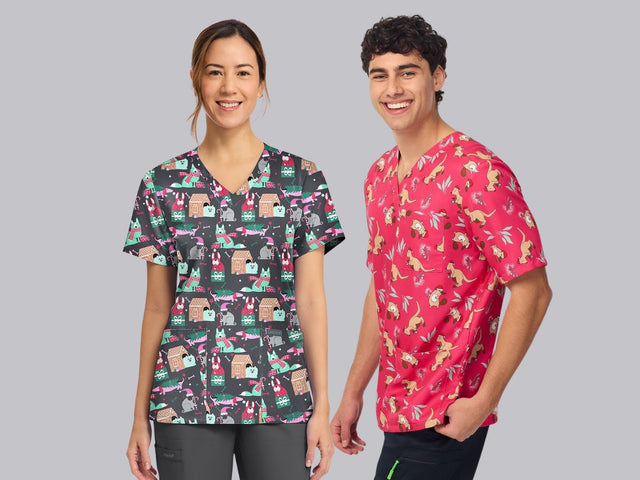
Lifestyle officers and diversional therapists work in activity spaces, gardens, common areas and resident rooms — environments where a purely clinical scrub can feel at odds with the homelike atmosphere the role is meant to create. Bright, cheerful printed scrubs are genuinely appropriate here and are actively encouraged by dementia care research, which shows that warm, high-contrast colours support orientation and positive emotional response in residents with cognitive impairment. Floral, botanical and warm-toned abstract prints work well.
Hospitality / Catering Staff
Kitchen, dining and catering staff have specific uniform needs shaped by food safety requirements. Food service contexts often call for a polo shirt or corporate-style top rather than clinical scrubs — the presentation signals hospitality rather than healthcare, which reinforces the homelike environment for residents at mealtimes. Dark colours — navy, black, hunter — are practical for food service environments.
Administration and Reception
Administration and reception staff are often the first point of contact for families and visitors. Their uniform should be professional and polished without looking clinical — a distinction that matters in aged care, where families are making emotionally significant decisions about their loved ones. A corporate-style top, polo or business shirt in the facility's brand colour is appropriate.
Community Care / Home Care Workers
Community and home care workers operate in residents' private homes rather than a facility environment. Polos or corporate shirts work better than scrubs here — they look professional without appearing overly clinical in a domestic setting. Clients receiving home care generally respond better to a neat polo with a facility logo than to a clinical scrub top. Easy-care, wash-and-wear fabrics are essential as community care workers often do their own laundering.
|
Role |
Garment |
Top Pick |
Suggested Colour |
Key Priority |
|
Registered Nurse |
Stretch scrubs |
Cherokee Infinity |
Navy / Burgundy |
Clinical ID, mobility |
|
Enrolled Nurse |
Stretch scrubs |
Wink W123 |
Ceil Blue / Teal |
Differentiated from RN |
|
Personal Care Worker |
Scrubs |
Dickies EDS / Wink W123 |
Wine / Hunter / Raspberry |
Durability, deep pockets |
|
Lifestyle / Diversional |
Printed scrubs or bright solid |
Cherokee Prints |
Warm tones / Florals |
Approachable, dementia-friendly |
|
Hospitality / Catering |
Polo or corporate top |
Polo shirt |
Navy / Black / Charcoal |
Food safe, homelike feel |
|
Admin / Reception |
Corporate top or polo |
Polo shirt |
Facility brand colour |
Professional, non-clinical |
|
Community / Home Care |
Polo or corporate shirt |
Polo shirt |
Facility brand colour |
Non-clinical in home setting |
Browse by category: Nursing Scrubs · Aged Care Uniforms · Polo Shirts · Printed Scrub Tops · Facility Orders
Colour-Coding by Department: Why It Matters in Aged Care
Colour-coding is more important in aged care than in almost any other healthcare setting. In a hospital, patients are generally admitted for defined, short-term episodes of care — they may not need to identify staff roles over time. In residential aged care, residents live in the facility long-term, often with progressive cognitive decline. Their ability to identify who is caring for them — who is a nurse, who is a care worker, who is delivering their meal — directly affects their sense of safety, orientation, and dignity.
For residents living with dementia, visual cues are often more reliable than verbal communication. A consistent, well-considered colour-coded uniform system gives residents a reliable way to understand who is in their environment without requiring them to read name badges or process complex verbal explanations. Dementia care research supports the use of warm, high-contrast colours for care staff — particularly the lifestyle and personal care teams who interact with residents most frequently. Cool tones like navy and ceil blue work well for clinical staff, where the signal of clinical authority is appropriate.
Colour batch consistency matters long-term: Once you have decided on colours, reordering the same ranges year on year from suppliers who maintain consistent colour batches is essential. A new starter whose navy looks noticeably different from the existing team's navy undermines the whole identification system. Cherokee, Dickies and Wink all maintain reliable colour consistency across production runs — which is why they are the brands most commonly used in multi-year facility uniform programs.
A well-designed aged care colour system typically separates at least four groups: clinical staff (RNs and ENs), personal care workers, lifestyle and activities staff, and non-clinical support (hospitality, admin, community care). Facilities that collapse these groups into a single uniform colour lose the identification benefit that colour-coding provides.
Scrubs vs Polos vs Corporate Shirts: How to Choose
The garment type decision in aged care is more nuanced than in a hospital or clinic. Different environments within the same facility may call for different uniform styles, and the wrong choice can undermine either the homelike atmosphere the ACQSC standards encourage or the clinical professionalism residents and families expect from nursing staff.
Scrubs are appropriate for all clinical and personal care roles — RNs, ENs, and personal care workers who are providing hands-on care all day. The easy-care performance, deep pockets, and freedom of movement that scrubs provide are genuinely suited to the physical demands of these roles. Stretch scrub fabrics also launder better at the high temperatures aged care settings often require, and they hold their colour more reliably than cotton alternatives.
Polo shirts strike the right balance for community care workers, lifestyle staff who prefer a less clinical look, and hospitality teams. A quality polo with an embroidered facility logo is professional, approachable, and clearly branded without resembling a clinical uniform. Polo shirts also work well in warm climates — particularly relevant for Queensland, WA and NT facilities — where a lighter, more breathable fabric is a practical advantage.
Corporate shirts and tunics suit administration, reception, and management roles where a business-professional presentation is appropriate. They project a polished, organised impression to families and visitors — which matters in an environment where families are making significant decisions about care placement and quality. Many facilities use all three across different departments, maintaining visual cohesion through a consistent colour palette and embroidered logo.
The Case for Printed Scrubs in Aged Care
Printed scrubs deserve a specific mention in aged care because they serve a function here that they don't in most other healthcare settings. In hospitals, printed scrubs are generally limited to paediatric units and similar environments. In aged care, there is a genuine evidence base for using warm, engaging prints — particularly for lifestyle and diversional therapy staff — as a tool for resident wellbeing.
Dementia care research indicates that visually stimulating, warm-toned environments support orientation, positive emotional response, and social engagement in residents with cognitive impairment. A lifestyle officer wearing a bright floral print top signals warmth and approachability in a way that a plain navy scrub does not — and in a diversional therapy context, this matters for the quality of the interaction that follows. Floral and botanical prints, warm abstract patterns, and seasonal prints are all appropriate for lifestyle roles.
Policy tip: Keep printed scrubs to appropriate roles and environments — lifestyle and diversional therapy — rather than using them facility-wide. Clinical staff in printed scrubs can undermine the visual identification system that colour-coding creates. A thoughtful printed scrubs policy specifies which roles can wear prints, which styles are approved, and how prints integrate with the facility's overall colour-coding system.
Fabric Guide: What Aged Care Demands
Aged care uniforms operate in a high-wash, high-contact environment. The fabric requirements are specific and worth understanding before making purchasing decisions at scale.
|
Attribute |
Why It Matters in Aged Care |
Best Options |
|
Wash durability |
Daily washing at 60°C+. Must hold colour and shape through hundreds of cycles. |
Dickies EDS, Cherokee Infinity |
|
Stretch and mobility |
Frequent bending, lifting, repositioning. Restriction causes fatigue and injury risk. |
Cherokee Infinity, Wink Boundless, Wink W123 |
|
Easy care |
Staff who launder at home need wrinkle-resistant, no-iron fabrics for compliance. |
Wink W123 microfibre poly, Cherokee Infinity |
|
Fluid resistance |
Incidental fluid contact is common in personal care and clinical roles. |
Dickies EDS, Cherokee Infinity (tighter weave constructions) |
Avoid 100% cotton in aged care settings — it creases badly, loses shape quickly with repeated high-temperature washing, and doesn't provide the stretch active care roles require. Polyester-dominant performance blends are the right choice across all direct care roles.
Ordering for Aged Care Facilities: What Makes It Work
Aged care facility uniform programs are among the most complex to manage because of the number of roles, the scale of the workforce, and the ongoing staff turnover that characterises the sector. Here is what makes facility-level uniform ordering run smoothly.
Five things that make facility uniform programs work:
Standardise early — lock in a colour-per-role system and consistent garment range before the first order. Every exception creates ongoing complexity. A simple documented uniform policy by role makes onboarding new staff straightforward.
Choose ranges with colour batch consistency — the single most important practical consideration for long-term facility management. Cherokee, Dickies and Wink maintain consistent colour batches across production runs, which is why they're the brands most commonly used in multi-year facility programs.
Size inclusively from the start — aged care workforces are diverse in body type. Build ordering around ranges that run XXS to 5XL to avoid the ongoing problem of new staff who can't be outfitted in the facility's standard uniform.
Plan for turnover — aged care has among the highest staff turnover rates of any care sector in Australia. Keep a small buffer stock of common sizes in each role colour so new staff can be uniformed on day one.
Embroidery simplifies identification — name and role embroidery on the left chest, combined with colour-coding, creates an unambiguous identification system. Once your facility logo is digitised with Infectious, reorders require no re-setup. Turnaround is typically 5–7 business days.
Managing a Facility Uniform Program?
Contact our business orders team to discuss colour selection, role-based ordering, logo embroidery and buffer stock management. Free shipping over $250.
Business & Facility Orders Embroidery Service Aged Care CollectionFrequently Asked Questions
Related Guides
→ What Colour Scrubs Do Nurses Wear in Australia? — Full Role-by-Role Guide
→ NSW Health Uniform Colours — Complete Scrub Colour Guide for Nurses
→ How to Wash Scrubs — Complete Care Guide for Medical Scrubs
→ Scrub Colours Explained — What Every Colour Means in Australian Healthcare
→ Best Scrubs Australia 2026 — Complete Brand and Buying Guide


